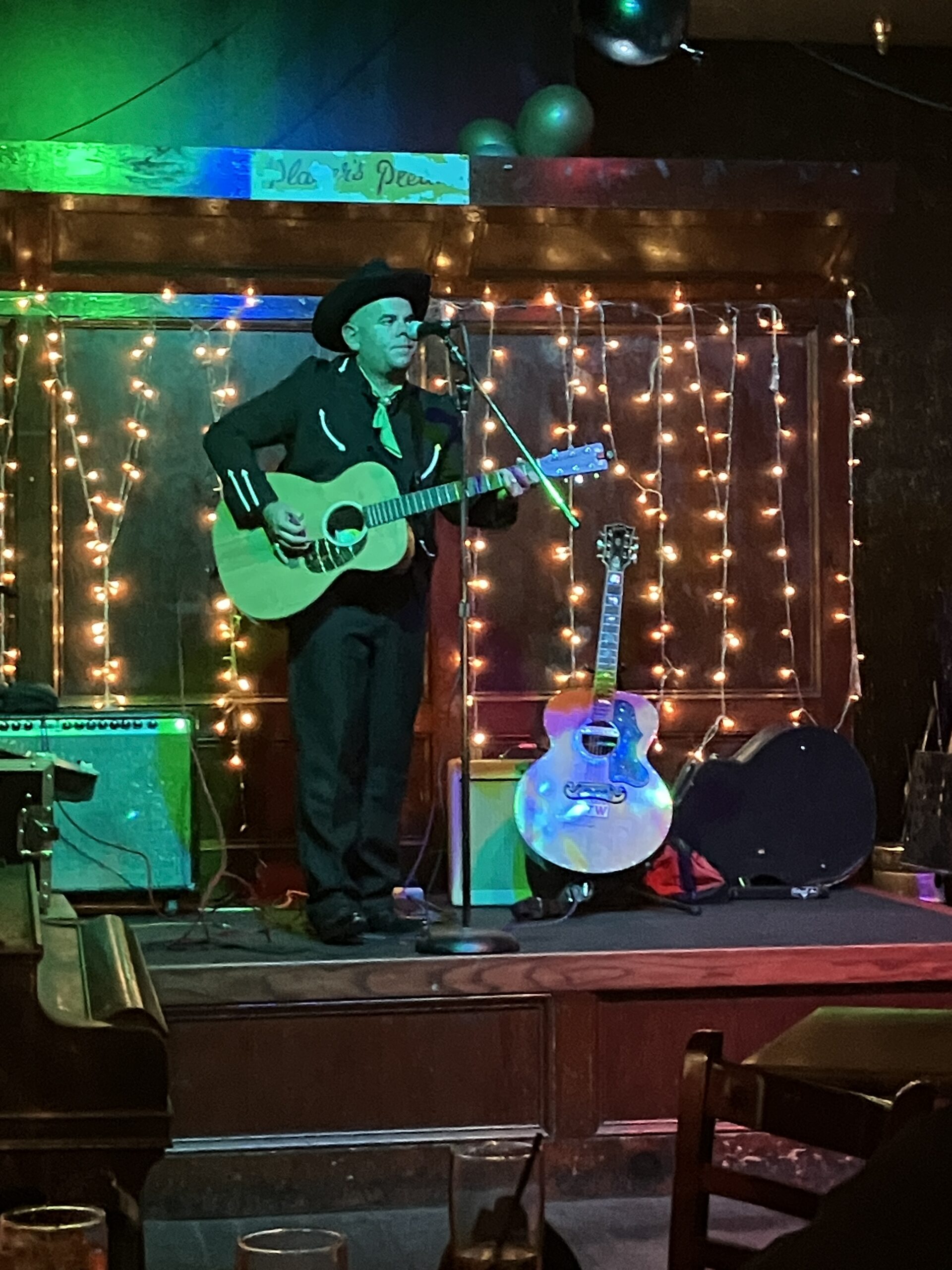
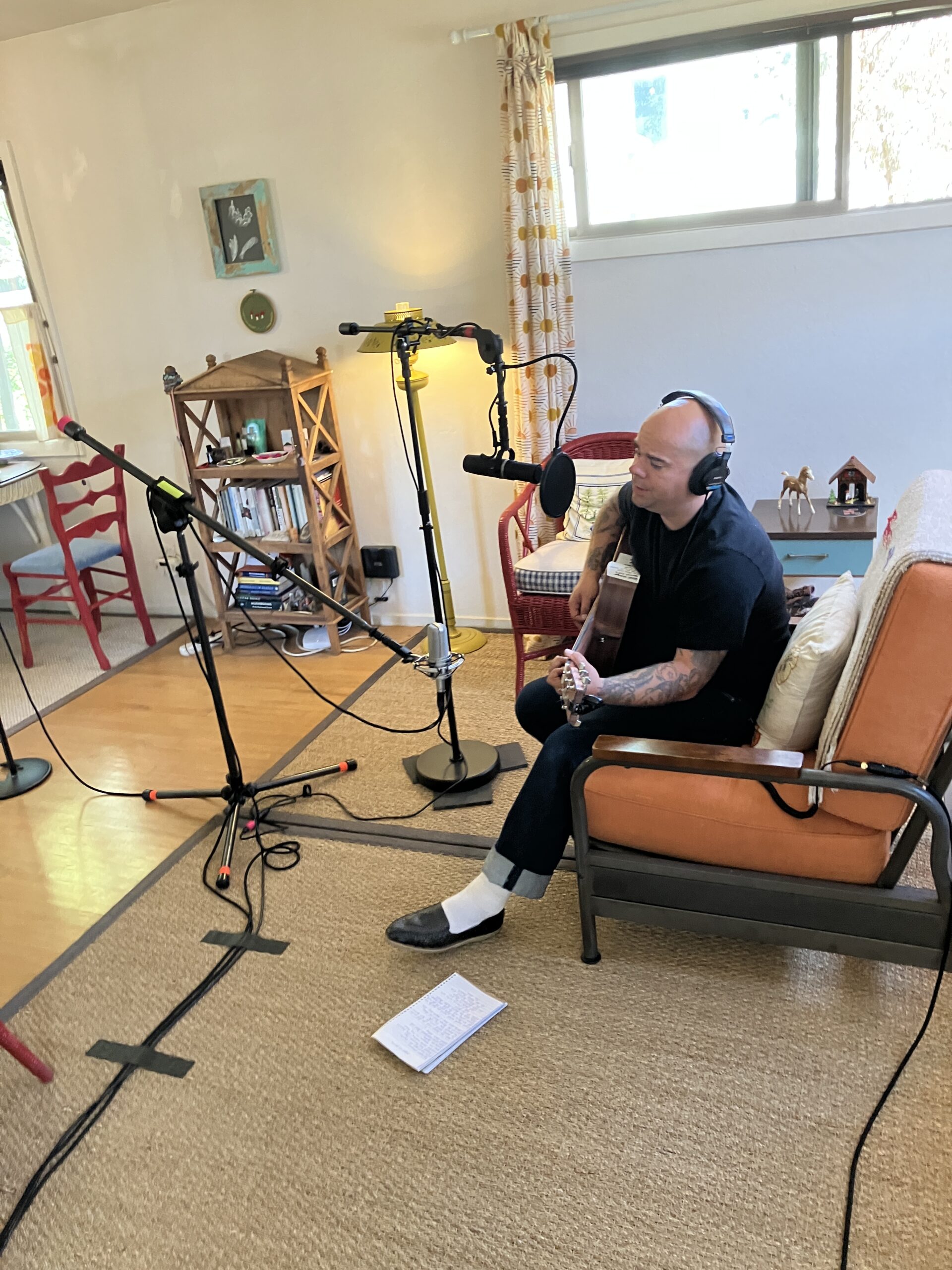
Richmond, CA—A few months back, Eric Roy Dinwiddie came by the studio to contribute a track to The Pub Album.
Posted in: Artist SpotlightWritten by: Logan ByrnePublished: Updated:
A collaborative compilation. He didn’t bring a polished demo or a tight arrangement plan. He brought a quirky original song, four friends he’d recruited as backup singers, and an afternoon’s worth of good humor.
The song is called In the Court of the King and Queen of Doubt. It’s not released yet, but it’s one of my favorite sessions we’ve tracked here, and it says a lot about who Eric is as a musician.
The Session
The tune sits somewhere between lounge music and Frank Zappa, with a healthy dose of Monty Python absurdism and a little Dada thrown in for good measure.
Drew Murray played drums. Bill MacBeath played upright bass — and then, mid-session, ran home to grab his marimba because the song needed it. That’s the kind of day it was.
SPLENDID
The four friends Eric brought weren’t there to sing harmony in the traditional sense. They mooed. They clucked. They made snide asides over the top of the track, and Eric welcomed all of it. When a take wrapped and the room settled, his verdict was simple: “Splendid.”
We got it in a handful of live takes with some overdubs layered on top, and then, just like that, everyone packed up and went home. No fuss, no second-guessing. That’s a specific kind of skill — knowing when a song is done and trusting the room to get you there. It’s also exactly the kind of session Panama Sound was built for: an untreated, character-filled space where a marimba run home to fetch mid-afternoon doesn’t feel like a disruption, it feels like the song asking for what it needs.
We’ll let you know when “In the Court of the King and Queen of Doubt” is out in the world. It deserves to be heard.
Who Eric Din Is
If the name rings a bell, it might be from the 1980s Berkeley ska scene. Eric Roy Dinwiddie — known for decades as Eric Din — co-founded The UpTones in 1981 while still in high school.
The band became a fixture at Berkeley Square and other East Bay venues, and helped set the stage for the ska-punk wave that broke nationally in the late ’80s and ’90s.
The “Din” name itself has a mundane origin story that Eric tells with the same dry humor that runs through his songwriting: while doing repair work at Subway Guitars in Berkeley, he shortened his last name on repair tickets to avoid confusion with a coworker who shared his initials. It stuck. In recent years, he’s returned to using his full name, Eric Roy Dinwiddie, on new solo work — a nod to his own roots.
The Solo Catalog
Eric’s solo material, released through his label Berkeley Cat Records, is mostly self-produced out of his home studio — he handles the songwriting, instrumentation, engineering, and mixing himself.
That DIY approach gives the records a loose, unfiltered quality that fits the songs, which range from ska and reggae-rock into synth-pop, schlager, and satirical spoken pieces.
A few places to start:
This Worldly World (2025)
A satirical look at digital-age fatigue and existential drift, delivered with hyper-catchy arrangements. The title track sets the tone, and “Me And The Little This Is Fine Fire Doggie” turns internet-era burnout into something genuinely funny and painfully accurate.
Street Party and CONTENT
Two full-lengths that balance lighthearted hooks with an undercurrent of cynicism. “Content, Content, Content” pokes at the pressure on artists to constantly feed the algorithm, while “Jupiter Girls” leans into playful, outer-space ska-pop.
Genre-bending cuts
“Much Better” features cover art from Bay Area cartoonist Shannon Wheeler, and “A Cat Named Paw” is a layered, home-studio love letter to a cat, produced with the same craft as anything he’s put out.
There’s also Berkeley Cat Records’ archival work — restored UpTones material transferred from 24-track analog tape, including In the Studio 1987, mixed and released decades after it was recorded at Music Annex in Menlo Park.
Where to Find It
Bandcamp: ericdin.bandcamp.com and ericroydinwiddie.bandcamp.com — the most direct way to support the work, whether digital or physical.
Streaming: Apple Music, Spotify, and YouTube, under Eric Din, Eric Roy Dinwiddie, and Berkeley Cat Records.
Logan is the owner and engineer at Panama Sound. He's been recording since age ten, with a 25-year detour in residential remodeling. His hobbies include photography, writing, and field recording. He loves the East Bay — the creative people here, and the life he's built in it.
Arhoolie, Down Home Music
Richmond, CA—The Field Holler that won't quit: Chris Strachwitz, Arhoolie, Down Home Music, and a Building Worth Saving.
A five-minute walk from Panama Sound, on the seam where El Cerrito’s sidewalk meets Richmond’s street address, sits a building that has quietly done more for American vernacular music than almost anywhere else on the West Coast.
For fifty years it has held a record store, a record label, and a film company under one roof, and for the last two years it very nearly didn’t survive its founder’s death. This is the story of how it got there, who built it, and why it’s still worth a visit — or a drive, or a plane ticket — today.
The Downhome Records storefront.
Christian Alexander Maria Strachwitz was born in 1931 in Gross Reichenau, a village in Lower Silesia then part of Germany, into an aristocratic farming family that lost everything when the region became part of postwar Poland.
He arrived in the United States as a teenager in 1947, and by his own account it was a chance encounter with a Lightnin’ Hopkins record that rewired his adolescence and, eventually, his career. He studied at Pomona College, taught high school for a stretch, and spent every spare hour chasing regional music at clubs, dance halls, and back porches.
In the summer of 1960 he made his first serious field-recording trip through Texas, Louisiana, and Mississippi, and that trip produced Arhoolie’s first release: a Texas songster named Mance Lipscomb, captured with the help of folklorist Mack McCormick, who also coined the label’s name from a regional term for a field holler.
Strachwitz left teaching in 1962 to run the label full-time, and in 1965 he began hosting a long-running Sunday program on Berkeley’s Pacifica station KPFA that stayed on the air for three decades.
That same year, a chance introduction to a young Berkeley folksinger named Country Joe McDonald led to a no-charge living-room recording session that yielded an anti-war anthem later immortalized at Woodstock — the royalties from which helped fund Strachwitz’s purchase of a building on San Pablo Avenue in the mid-1970s, which became Arhoolie’s headquarters and, from 1975 onward, the Down Home Music store.
In 1995 he founded the nonprofit Arhoolie Foundation to house and preserve his archives, and in 2016, at 85, he sold the Arhoolie label’s catalog to Smithsonian Folkways, which continues to distribute it worldwide. Chris Strachwitz died on May 5, 2023, at 91, having spent more than six decades as one of the most consequential independent record men in American history.
What makes Arhoolie’s catalog remarkable isn’t just its size — more than 350 albums across six decades
— but its refusal to specialize. Strachwitz’s ear moved fluidly between deep Texas blues, Louisiana Cajun and zydeco, Tejano and norteño conjunto, Appalachian old-time, gospel steel guitar, and Balkan-American brass, treating all of it as equally worth preserving.
The blues wing alone reads like a syllabus: Lightnin’ Hopkins, whom Strachwitz first recorded in 1959; Mance Lipscomb; Mississippi Fred McDowell, whose “You Got to Move” was later covered by the Rolling Stones on Sticky Fingers; Big Mama Thornton; Big Joe Williams; Robert Pete Williams; Juke Boy Bonner; Lil’ Son Jackson; the Black Ace (B.K. Turner); pianist Alex Moore; Texas songster and pianist Robert Shaw; and the singular one-man-band percussionist Bongo Joe Coleman, recorded on the streets of San Antonio.
On the Louisiana side, Clifton Chenier — the self-styled “King of Zydeco” — anchored a roster that included his son C.J. Chenier, Amede Ardoin, Alphonse “Bois Sec” Ardoin and his sons, fiddler Canray Fontenot, John Delafose, and the Sam Brothers Five.
Arhoolie’s Tejano and norteño catalog grew enormously in 1990 when Strachwitz purchased the masters of Ideal Records, bringing in Lydia Mendoza, Chelo Silva, Carmen y Laura, conjunto pioneer Narciso Martínez, orquesta bandleader Beto Villa, accordionist Valerio Longoria, Flaco Jiménez, Santiago Jiménez Jr., and groups like Los Alegres de Terán and Los Pingüinos del Norte. Beyond those three pillars, the label’s reach touched Rose Maddox, Freddy Fender, Cuban percussionist Francisco Aguabella, old-time fiddler Tommy Jarrell, and — in one of the odder detours in the catalog — an early living-room recording of Country Joe McDonald himself.
Whether you know all of these names or none of them, that’s the point: Arhoolie’s mission was never chart position, it was documentation, and the sheer range of the roster is the clearest evidence of how seriously Strachwitz took that job.
Strachwitz’s closest creative partner outside the studio was Les Blank, the documentary filmmaker who moved to the Bay Area in the 1960s and spent the next five decades training his camera on American vernacular culture — music, food, and the people who made both.
Blank and Strachwitz collaborated directly on three films: Chulas Fronteras (1976), an intimate portrait of Tejano and norteño border culture built around performances by Flaco Jiménez, Lydia Mendoza, and Narciso Martínez; its companion piece Del Mero Corazón (1979); and J’ai Été au Bal (1989), a tribute to Cajun and zydeco music. Blank also made standalone documentaries on Arhoolie artists, including The Blues Accordin’ to Lightnin’ Hopkins and Hot Pepper, his profile of Clifton Chenier, and both Chulas Fronteras and Blank’s garlic documentary Garlic Is As Good As Ten Mothers were later selected for preservation in the Library of Congress’s National Film Registry.
Blank’s other lifelong creative partnership was with Werner Herzog, and it’s worth understanding how that connection sits alongside the Strachwitz story rather than folding into it directly — the two threads run parallel more than they intertwine.
Blank first turned his camera on Herzog for the short film Werner Herzog Eats His Shoe (1980), documenting Herzog making good on a wager to eat his own boot, and followed it two years later with Burden of Dreams (1982), his acclaimed making-of chronicle of Herzog’s famously grueling Fitzcarraldo shoot in the Amazon — widely regarded as one of the finest documentaries ever made about the act of filmmaking itself.
Herzog and Blank remained friends and mutual admirers for the rest of Blank’s life; Herzog later spoke on camera about his admiration for Blank’s Appalachian old-time film Spend It All.
The throughline connecting all of it is Blank himself: the same restless, unpretentious camera that captured Herzog eating a boot in Berkeley also captured Flaco Jiménez’s accordion runs on the Texas border, because to Blank they were both, in their own way, documents of people doing something with total conviction.
Strachwitz’s reputation, almost uniformly, is that of a fair dealer in a field with a long history of exploitation — folklorists and A&R men who recorded regional and Black vernacular artists for a pittance and kept the publishing for themselves.
Strachwitz went out of his way to avoid that pattern more than once: when the Rolling Stones covered Mississippi Fred McDowell’s “You Got to Move” on Sticky Fingers, Strachwitz pushed back against resistance from the band’s lawyers and secured McDowell substantial royalties while the ailing bluesman was still alive to receive them.
That said, the historical record isn’t entirely without tension. Some blues performers, wary of Arhoolie’s small, niche-market distribution, chose upfront cash payments over deferred royalties — a rational choice at the time, but one that meant they didn’t share in whatever long-term value their recordings accrued.
And the most financially significant transaction in Arhoolie’s history was, on its face, a lopsided one: Strachwitz recorded a young, then-unknown Country Joe McDonald for free in his living room in 1965, and in exchange received the publishing rights to “I-Feel-Like-I’m-Fixin’-to-Die Rag,” which went on to become a Woodstock-era anthem and effectively bankrolled the label’s growth and its eventual real estate.
Scholars examining Strachwitz’s larger body of work have also noted the basic outsider dynamic inherent in his career — a white, German-born collector of considerable means built his life’s work by documenting predominantly Black, Cajun, and Mexican-American communities — a dynamic Strachwitz himself was self-aware about, and one that shows up in academic discussions of field recording ethics more broadly.
Strachwitz was a serious 78 rpm collector before he was a record executive, and that habit metastasized over sixty years into one of the largest privately assembled recorded-sound archives in the country.
The bulk of it now lives as the Strachwitz Frontera Collection of Mexican and Mexican American Recordings, owned outright by the Arhoolie Foundation and comprising close to 170,000 individual recordings — 78s, 45s, LPs, cassettes, and unreleased reel-to-reel masters — spanning from 1905 through the 1990s, including the earliest known commercial recordings of corridos, rancheras, and norteño and conjunto music.
Rather than shipping the physical collection off to a university archive, Strachwitz and the Arhoolie Foundation struck a digitization partnership in 2001 with UCLA’s Chicano Studies Research Center, seeded by a $500,000 grant from the Los Tigres del Norte Foundation, the philanthropic arm of the Grammy-winning norteño group.
The physical 78s and related materials stayed — and still stay — at the Arhoolie Foundation’s own facility in El Cerrito, while a growing digital mirror, now well over 140,000 recordings, is hosted online by the UCLA Library in partnership with the university’s Digital Library Program.
The broader Arhoolie label catalog — the blues, Cajun, zydeco, and gospel recordings that made up the commercial label itself, as distinct from the Frontera Collection’s raw historical 78s — followed a different but complementary path in 2016, when Strachwitz sold it to Smithsonian Folkways, ensuring national distribution and long-term institutional stewardship while the foundation retained the archival materials, photographs, and unreleased tape.
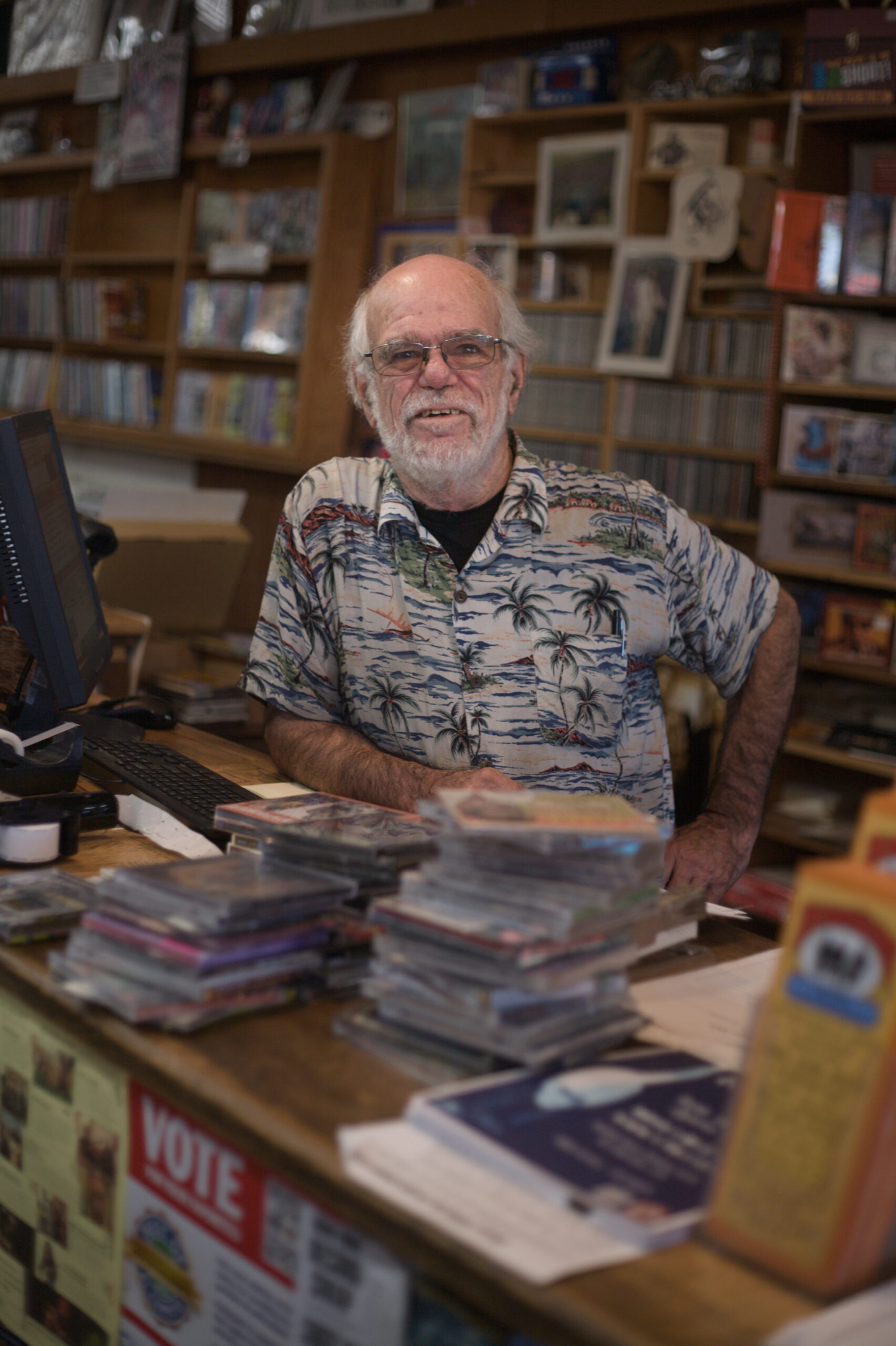
If Chris Strachwitz was Down Home Music’s founder, John McCord has been its constant.
McCord has managed the store since the early 1980s — well over four decades now — co-running day-to-day operations alongside J.C. Garrett, who joined in 2003. Between them, McCord and Garrett are the reason Down Home Music has remained a functioning, browsable, staffed record store through a change in ownership, a founder’s death, and a real-estate crisis that could easily have ended it.
John McCord behind the counter at Down Home Records. Photo by Logan Byrne.
McCord has also been the store’s public face and institutional memory through all of it — quoted in nearly every piece of press coverage of the building’s recent troubles, and the person visitors are most likely to actually talk to when they walk in the door.
It’s worth saying plainly, as someone who runs a studio a few minutes away: John’s generosity extends well past the counter. He graciously made time to come record a handful of songs at Panama Sound, and one of those recordings will appear on our upcoming Pub Album compilation.
That kind of willingness — a man who has spent forty years being the steady hand behind one of the most important roots-music institutions on the West Coast, taking an afternoon to sing into someone else’s microphones — says as much about the culture Strachwitz built as any catalog number does.
It’s the same ethos Down Home has always run on: music first, ego optional.
Chris Strachwitz personally owned the San Pablo Avenue building that housed Down Home Music, Arhoolie’s offices, and Les Blank Films for nearly fifty years, and his death in May 2023 put that arrangement on a clock.
His will granted Les Blank’s son, filmmaker Harrod Blank, a first right of refusal to buy the property, but in October 2024, the Strachwitz family trust announced it planned to put the building on the open market, and all three tenants — Down Home Music, the Arhoolie Foundation, and Les Blank Films — publicly acknowledged they could lose the space that had defined all three organizations for half a century.
Harrod Blank exercised his option in partnership with the Arhoolie Foundation, and the two nonprofits went under contract on the property in November 2024, putting down 10 percent earnest money on an appraised purchase price of roughly $2.4 million, with a deadline in the spring of 2025 to raise the balance. A public GoFundMe campaign — shared across all three organizations — drew more than 300 donors and roughly $67,000 on its own, much of it arriving in a rush of year-end tax-deductible giving.
But the deal was ultimately closed thanks to one major donor whose identity and exact contribution Harrod Blank has kept private, calling the gift the thing that let the purchase clear the finish line.
By mid-2025, the sale was complete: the Arhoolie Foundation and Les Blank Films are now co-owners of the building, with Down Home Music remaining as tenant — a “marriage of the three entities,” as Blank put it, formalizing a relationship that had operated informally for fifty years.
One complication remains unresolved: much of Down Home Music’s retail inventory technically passed to Strachwitz’s heirs along with the rest of the estate, and the store is still working out whether and how to purchase that inventory back at what Blank has described as an unexpectedly steep appraised value.
With ownership secured, the three organizations are already leaning into what the building has always done best: functioning as a live venue and community gathering space, not just an archive and a retail counter.
Down Home has hosted informal in-store sets for years — Taj Mahal has dropped in to jam, and performers including, Johnny Otis and Peter Rowan have played there over the decades — and McCord and Blank have both talked openly about expanding that programming, with more scheduled live music and Harrod Blank, a filmmaker himself, pushing to bring regular film screenings into the mix.
Down Home Music also continues to anchor community events like the El Cerrito Free Folk Festival, hosting preview performances in its own space ahead of the annual festival.
It’s genuinely hard to overstate what this building represents for the region. Technically, Down Home Music sits in the city of Richmond — the sidewalk out front is El Cerrito’s, the storefront is Richmond’s — which makes it a fitting, almost literal symbol of an East Bay music culture that has never much cared about municipal boundary lines.
For El Cerrito, it’s one of the only surviving links to a moment when the town was a real node in the national roots-music map. For Richmond and the wider East Bay, it’s proof that an independent, artist-first business model can outlive its founder if the community around it decides it’s worth fighting for.
For the Bay Area more broadly, it sits alongside a shrinking handful of institutions — record stores, small labels, listening rooms — that still treat regional and vernacular music as worth documenting on its own terms rather than optimizing it for a platform’s algorithm.
And nationally, Arhoolie’s catalog and the Frontera Collection remain foundational reference points for anyone studying American blues, Cajun, zydeco, or Tejano music — the kind of archive that university researchers, documentarians, and touring musicians alike still go back to, more than sixty years after a 250-copy Mance Lipscomb LP started the whole thing.
Support Independent Music
Down Home Music
Go Visit. Sign Up. Show Up. If you’re a new client of Panama Sound, a returning one, or just passing through the East Bay, put Down Home Music on your list.
It’s a short walk from the studio, the bins are deep, the staff — John and J.C. especially — actually know what they’re talking about, and every dollar spent there supports the same community fabric this whole studio operates inside of.
Sign up for their email list so you know when the next in-store set, screening, or Free Folk Festival preview lands, and if you’re in town when something’s happening, go. This is exactly the kind of independent, artist-first infrastructure that’s disappearing everywhere else in the music business — it survived because people showed up for it once already. It’s worth doing again.
A Small Postscript on Coincidence
I went to high school at MacGregor in Albany, a continuation school, and in the 90s I spent a fair number of nights at Berkeley house parties with a kid named Devin McDonald. Then one day he was in class with us. I guess, like me, he’d been transferred from regular high school for [reasons].
I had no real sense at the time that his last name meant anything beyond a name — he was just a friend, one more person in class, one more person at one more party. Though he had a big, zany personality, he was always laughing.
Devin is Country Joe McDonald’s son. The same Country Joe McDonald whose free living-room recording session with Chris Strachwitz in 1965 turned into a Woodstock-era anthem, funded the purchase of the Down Home Music building, and indirectly built the roof under which John McCord has spent the last forty-plus years.
Devin, for what it’s worth, grew up a few blocks from Mr. Mopps’ Toy Shop on Martin Luther King Jr. Way, fell for the place as a kid, and bought it with his partner Jenny Stevenson in 2010 when it looked like it might close for good — he’s been running it, and raising his own family, ever since.
I don’t know what to call a coincidence like that beyond just naming it. A regional record label funded in part by a song written by a man whose kid I used to hang around with as a teenager, in a building five minutes from a studio I’d end up owning thirty years later, staffed by a man generous enough to come sing into my microphones for a record I’m putting together right now. Call it a small town, call it the East Bay being smaller than it looks, call it serendipity or providence or nothing at all — but it’s the kind of throughline that makes me want to keep paying attention to where I actually live, and who’s actually in it.
I wrote something a little different this time, more personal than the usual studio stuff. It’s about my early obsession with recording music. I didn’t go into the piano lessons that didn’t take or band in middle school — that didn’t quite stick for various reasons, one of them — I think, was that I simply loved to record. From frenetic courtyards in the UC Village, to foggy nights in the lonely hills, stolen moments, a lot of late nights radio surfing, and not sleeping much.
Logan is the owner and engineer at Panama Sound. He's been recording since age ten, with a 25-year detour in residential remodeling. His hobbies include photography, writing, and field recording. He loves the East Bay — the creative people here, and the life he's built in it.
The Independent Artists Guide
Richmond, CA—Your step-by-step roadmap for navigating the modern music landscape on your own terms.
Posted in: For ArtistsWritten by: Logan ByrnePublished: Updated:
Releasing music as an independent artist means wearing every hat, from sound engineer and visual director to distribution manager and marketing strategist. This hub keeps growing — check back occasionally for new parts.
I do a few things here: I record; I mix; I hand off. The rest is completely up to you. It can be daunting—that’s why I’ve created this series.
From the moment your masters are in your hands, the rest is yours to run — copyright, distribution, marketing. Pushing hard for your record’s visibility isn’t selling out; a killer track nobody hears helps no one. Treating the release like a business is the highest compliment you can pay the art. This guide is where you start.
Nine-Part Guide
In This Series
Nine standalone guides covering everything that happens after you leave the studio — rights, strategy, storefronts, distribution, playlisting, physical media, radio, and live shows.
Logan is the owner and engineer at Panama Sound. He's been recording since age ten, with a 25-year detour in residential remodeling. His hobbies include photography, writing, and field recording. He loves the East Bay — the creative people here, and the life he's built in it.
The Waterfall Music Release Strategy
Richmond, CA—How to Release an Album Without Watching It Evaporate,
Posted in: For ArtistsWritten by: Logan ByrnePublished: Updated:
Putting your record on Spotify, Apple Music, and Amazon isn’t a business plan. It’s a business card. A shiny one — but nobody’s ever retired on business cards.
The waterfall strategy turns that business card into an actual campaign: release in stages — pre-order, then singles, then the full flood — each one bundling in everything before it. Every drop reads as “fresh” to the algorithm while older tracks ride along and keep racking up plays. Less a single event, more a slow, deliberate leak, timed to stay relevant for months instead of one expensive weekend.
Streaming Is Your Business Card, Not Your Business. Streaming does real work — the modern record store and radio station fused into one tap, with genuine algorithmic and editorial discovery, plus dashboard data that can shape where you tour. But it pays pro-rata, fractions of a cent per play; you’d need millions of streams just to cover studio time, let alone pay yourself.
Platforms treat your record the way a utility company treats electricity: always on, rarely chosen, forgotten the moment the bill is paid. So below are some options.
Own the relationship, not just the reach. Bandcamp, physical media, your own storefront — is the actual relationship. Higher margins, real fans, total control. Or, let one feed the other. Use streaming as the wide net and keep your best material — high-res masters, bonus tracks, limited runs — on channels you own outright. Broad reach turns into an audience you keep, not one you’re borrowing. Alternatively, take it off-algorithm entirely. Community and college radio, and the live show, carry a credibility no algorithm fakes yet. Play the new single live before it streams, then close the loop at the merch table — physical media, mailing list, a QR code to your storefront.
The Waterfall, Phase by Phase
This shouldn’t need to be mentioned, but you never know: This article assumes you have at least enough songs to release an EP, songs that are completely finished. Not one last overdub needed, not “I’m going to get it mastered soon.” Finished, full-stop.
This is the phased model I recommend to every artist leaving Panama Sound with a finished record — stages spaced four to six weeks apart, priming your own fanbase before you ever ask a platform for a favor. Releasing everywhere on the same Friday is the fastest way to let months of work vanish into an oversaturated feed.
Phase Zero — Storefront (Optional)
Optional groundwork: your own storefront (domain, WordPress + WooCommerce, Stripe or Square) sells digital downloads with no platform between you and the fan’s wallet. Physical adds real complexity — print-run inventory versus thinner-margin on-demand fulfillment — and it’s its own project, not something to bolt on between mixing sessions. A dedicated how-to is coming; most artists should start at Phase One.
Phase One — The Bandcamp Pre-Order
Open with an exclusive Bandcamp pre-order — fans pay now to lock in the full record, funding the finish line rather than buying what’s already on the shelf. Keep the whole album behind the pre-order, with one or two tracks unlocked immediately, rather than fragmenting it; collectors resent being sold a partial release only to see a fuller version drop later. The window generates high-margin revenue to reinvest in the campaign and captures the email addresses of the people who’ll actually buy a ticket.
Phase Two — Singles, Stacked
Move into streaming with singles roughly a month apart, using strict multi-track distribution: Single B ships as a two-track release including Single A; Single C includes both A and B. The ISRC for each song must stay identical across every single it appears on, so plays and saves stack instead of fracturing across duplicate entries. This isn’t just tidy — Spotify only lets you pitch one song per release for editorial consideration, and Release Radar fires once per release, per follower. Three or four singles over a few months means three or four real shots at algorithmic placement, instead of burning the whole record on one Friday.
Phase Three — The Flood
The final phase unlocks the complete project everywhere at once. By now you’ve spent months building the Bandcamp pre-order audience and driving repeat plays on each single — you’re not pitching cold, you’ve already taught the algorithm that people listen to, save, and repeat these songs. Point that pre-warmed audience at the full album in one coordinated push; that first-day wave is what triggers algorithmic momentum, and turns it into recommendations.
None of this should tip you into burnout — spacing releases four to six weeks apart also gives you room to actually tell each song’s story instead of dumping everything at once. Building a waterfall this deliberately, registering your copyrights, managing your metadata like a professional: none of that is a compromise on the art. It’s the most respectful thing you can do for a record that cost you time, money, sweat, and tears.
Logan is the owner and engineer at Panama Sound. He's been recording since age ten, with a 25-year detour in residential remodeling. His hobbies include photography, writing, and field recording. He loves the East Bay — the creative people here, and the life he's built in it.
Douglas Benson, The Desert Stranger
Richmond, CA—I met Douglas Benson outside the Ivy Room in the Spring of 2026, before any of this started.
Posted in: Artist SpotlightWritten by: Logan ByrnePublished: Updated:
He’d just finished opening for Mitch Polzak and the Royal Deuces, playing for maybe thirty people who weren’t paying much attention.
Douglas Benson performing.
It didn’t matter. He played that room like it was a sold-out arena of ten thousand people who’d come just for him.
That’s the whole thing about Doug — the audience size has never once changed what he gives them.
I told him I had a studio. I asked him to come down. I didn’t expect him to say yes. I didn’t think much of it because this is The Bay Area and people talk a good game but they’re just as likely to flake as not.
My Good Friend, Logan
Before we’d ever recorded a note together, Doug did a live broadcast on KXSF.
I was at home, listening and recording, no idea what was coming. At some point, completely apropos of nothing, he introduced me to the DJ on air as “my good friend, Logan” — and called out the studio and Richmond along with it.
Douglas Benson talking about music, influences and life on KXSF in 2026.
We’d met exactly once, outside a bar, after a short conversation. He didn’t owe me that. I had to pick my jaw up off the floor.
The next day I drove into the city for his show and brought him a Panama Sound t-shirt — probably a size or two too big, if I’m honest.
Punk Rock, Hank Williams, and Low Riders
Douglas has been playing punk rock most of his musical career, and like he said on the radio, punk is just country sped up. So it was natural for him to slow down into country music, but here’s the catch:
Western, Not Country
He followed through on the studio, too. A few weeks later he was standing in my living room in Richmond, ready to work.
Doug is insistent on one distinction: it’s not country, it’s western. Country has Nashville in its bones. What Doug writes and sings comes from somewhere else — a desert landscape he describes as magic from the ground to the sky. A windblown border town in Arizona.
You can hear that in the songs: wide open, a little haunted, built for a horizon across a dashboard.
LB: When did you get started making music?
DB: I started playing violin in elementary school.
LB: What instruments do you play?
DB: Violin, guitar, banjo, bass, drums,
LB: When did you start writing songs?
DB: Wrote my first song when i was 14.
LB: Why did you start writing songs?
DB: I knew I didn’t want to be in a cover band or a band that did a lot of covers, so… I wrote my own stuff. [I] have kept that mindset to this day.
LB: How do you recognize an idea as a song?
DB: A melody or line will pop into my head, i won’t be able to shake it until it’s done and written.
LB: Where did you grow up?
DB: Born and raised in california, deep east bay, ANTIOCH! but spent quite a bit of time in Arizona as a kid, way south east in the Sonoran Desert.
LB: How did that influence your music?
DB: Growing up in Antioch: I was a chicano rockabilly kid that listened to punk rock, rockabilly and drove a low-rider. i think most people thought I was from space. I was fine with that. spending time in Arizona, i just really soaked in all that heat and magic out there. it all translates somehow.
LB: What music or scene did you fall into or what attracted you?
DB: Rockabilly, psychobilly and punk rock.
LB: What was unique or idiosyncratic about your musical taste?
DB: I’d have to thank my parents here. they have the most epic vinyl collection. One day it’d be classical, the next Motorhead, and everything in between. I think that’s the best way to be.
LB: What bands did you form or play in?
DB: I started stigma 13 when i was 15, and that band is still goin’ today. Big time punk rock n roll. I’ve been doing my western project for about a year and I’ve been having a lot of fun with it.
LB: Are there websites, bandcamp, spotify, or youtube links you would like to share in regards to your previous punk rock bands?
DB: There’s some stuff on youtube if you dig for stigma 13, but we’ve always been a live band and that’s the best place to see and hear us.
LB: What drew you to Western music? Why did you stop playing punk rock?
DB: Western music and punk rock are kinda one and the same to me. It’s all about existing outside of the regular confines of society. I think that’s what I dig most about it all.
LB: Where were you when you were first inspired to play Western music?
DB: I donno if there was ever one time where it was like some kind of lightening bolt… it’s always kinda been knocking around in there. I do see it like a movie though. the songs are the soundtrack.
LB: Why were you inspired?
DB: I think with any of my music projects, i just wanna write the songs i wanna hear. it’s as simple and as complicated as that. haha
LB: Who are some of your Western influences?
DB: tuco. bob dylan. george jones, hank williams sr, lefty, spaghetti westerns, townes, louvin brothers, harry mcclintock…too many to list
LB: What are you doing nowadays mostly?
DB: workin, bein dad, and writing music. it’s a good life.
LB: Where can people see your show?
DB: just gotta keep an eye on the horizon for the desert stranger
LB: What are your favorite venues to play/places to hang out?
DB: i don’t think ive ever had a bad time playing anywhere, im just happy to play anywhere that’ll have me!
LB: Where can people find a schedule of your shows?
DB: check the instagram, i post a lot of junk there
LB: Anything in the works?
DB: well, as it would turn out i’ve done some recording at panama sound, and wanna get a few more songs in the can!
LB: Are you planning a release?
DB: yep!working on it!
LB: Do you, or would you like to collaborate with other musicians?
DB: always
LB: What are your favorite and least favorite parts of the music business?
DB: it can be clique-y at times and that’s lame as fuck. there’s enough room for everyone if ya ask me.
LB: What do you think it’s all for?
DB: shit, i ask myself that daily. let me know if anyone else figures it out.
LB: Why do you keep doing what you’re doing?
DB: simply put, because i can’t not.
LB: Any advice for new musicians just coming up in the game?
DB: buckle up and have fun. don’t take shit too serious.
LB: Anything else you’d like to add?
DB: i think we all need to sit back and take a deep breath. think long and hard about the things in life that really matter. we can feed the hungry, and we can house the poor. the sky is gonna be blue tomorrow wether we’re here or not, so we might as well enjoy it all with eachother.
Douglas Benson in-studio.
Eight tracks in a single six-hour session. No overdub marathons, no sanding off the rough edges — just Doug, a room, and the songs as he actually plays them live. That’s the only way to record someone whose whole gift is presence. You capture it, you don’t fix it.
That’s my good friend, Doug, start to finish — the guy who’ll play like the room is packed when it’s not, give credit on the radio when nobody’s asking him to, and show up to make good on a promise to a stranger outside a bar.
We’ll point you in the right direction when he releases his new album.
Logan is the owner and engineer at Panama Sound. He's been recording since age ten, with a 25-year detour in residential remodeling. His hobbies include photography, writing, and field recording. He loves the East Bay — the creative people here, and the life he's built in it.

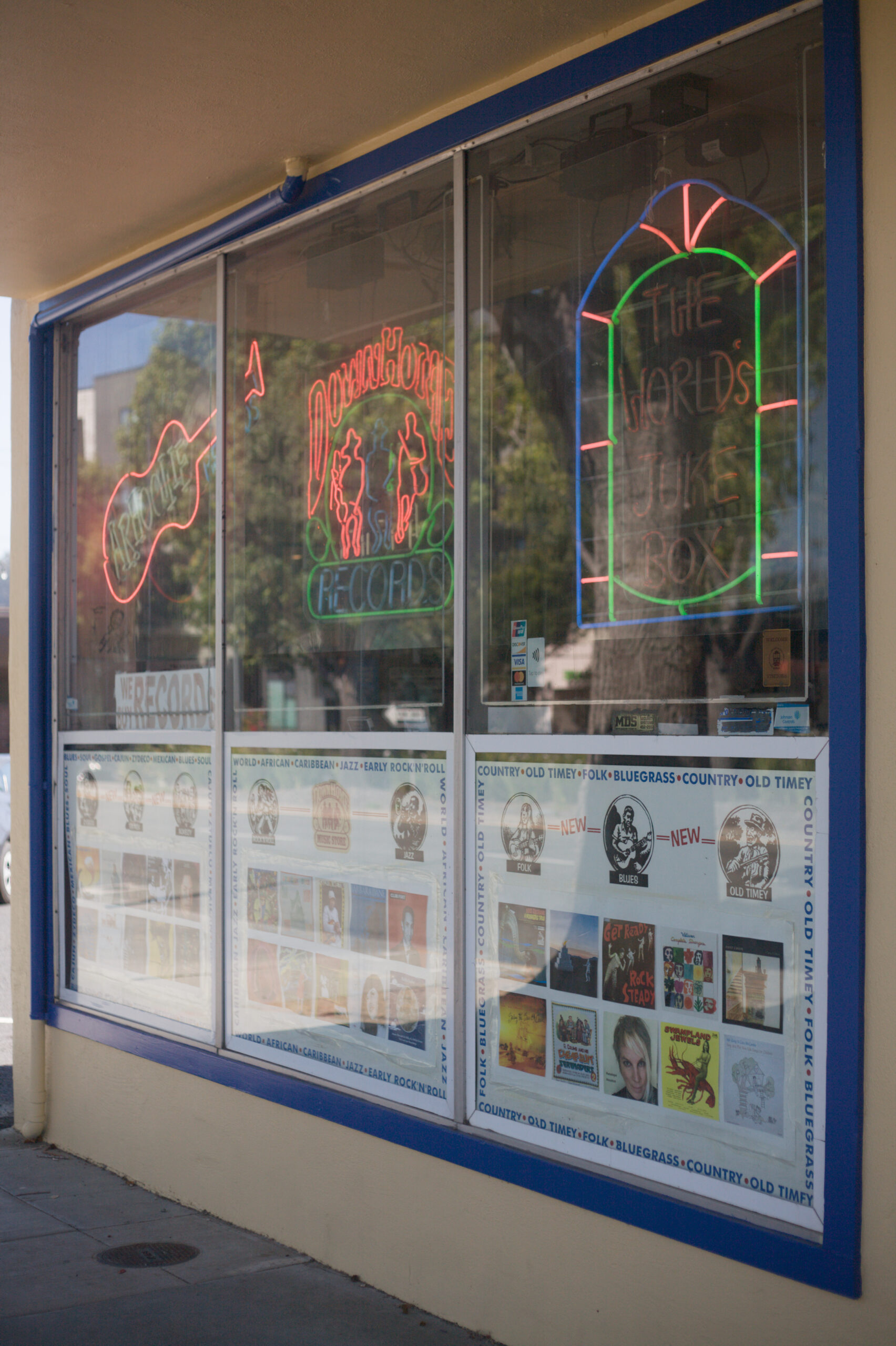 The Downhome Records storefront.