He’s got a lust for life that doesn’t seem to have an off switch, an energy that’s flat-out infectious, like a kid who just found the one present under the tree he’d actually been hoping for. Except that’s not a Christmas morning thing for him. That’s a Tuesday.
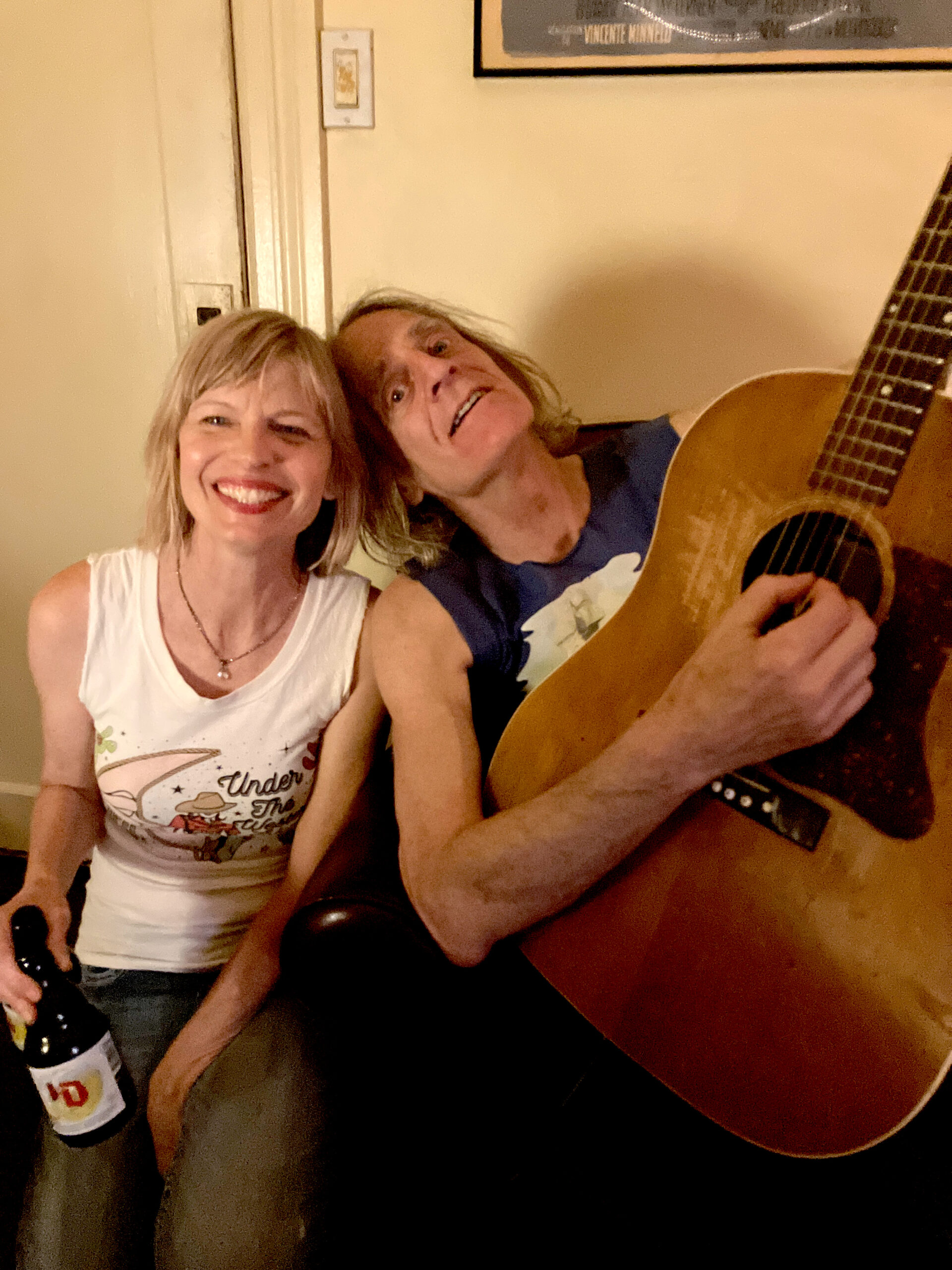
It took me a while to piece together why THIS guy and that guitar was sitting in a Bay Area bar and not, say, headlining somewhere. Turns out he’s been headlining somewhere — just not here, and not for a while – though I managed to catch him with Psycotic Pineapple at the Ivy Room last year and Hotel Utah with his combo, The Alex Carlin Triad this year.
Alex Carlin has been paying dues since before most of us were born, and the receipts span five decades, three continents, and a Guinness World Record. This is his story, or at least the parts of it that fit on a page.
Berkeley, Fifth Grade
Carlin was born in Chicago in 1957, and his family landed in the Berkeley hills around 1964.
The origin story is almost too on-the-nose for a kid who’d grow up to make a career out of rock and roll: in 1967, in fifth grade at Cragmont Elementary, he and classmate Jon Rubin started a band called
The Constipated Orange
.
It was band named after a joke — a satirical jab at the psychedelic acts of the day, the Electric Prunes and Strawberry Alarm Clock types — but the partnership with Rubin stuck around a lot longer than the joke did.
The Rubinoos
By 1970, that same partnership had turned into something real.
Carlin playing a cheap Italian organ, was a founding member of The Rubinoos alongside Jon Rubin, Tommy Dunbar, Greg “Curly” Keranen, Ralph Granich and Danny Wood — melodic, hook-heavy, unmistakably indebted to the British Invasion.
He co-wrote Rock and Roll Is Dead (And We Don’t Care), the song the Rubinoos played on American Bandstand, and was recently featured on HBO FRANCE’s Irma Vep movie.
Carlin’s run with the band was brief — a year, maybe two — but it’s the kind of credit that tells you he was in the room early, doing real work, before almost anyone in the East Bay scene had a name for what they were doing.
Psycotic Pineapple and the Berkeley Punk Years
By the late ’70s Carlin had moved from power-pop into the noisier, faster world of Berkeley punk with Psycotic Pineapple.
He found a songwriting partner in bassist John Seabury — a Grammy-nominated illustrator as well as a musician — and together they wrote live staples like I Forgot Who I Was. This was the era of shared bills with the Dead Kennedys, Jonathan Richman, Roky Erickson — the East Bay’s version of a proving ground, and Carlin was squarely in the middle of it.
- Buy music: Psycotic Pineapple
A Detour Through Hollywood
In 1984, Carlin, Dunbar, and Seabury wrote Little Demon together.
Rick Derringer produced it, Adrian Zmed performed it, and it landed in Bachelor Party, the Tom Hanks comedy that was tearing up theaters that year.
It’s a strange, fun footnote — a Berkeley punk guy with a songwriting credit in a mainstream studio comedy — and it’s the kind of thing that could have pulled a lesser artist toward chasing more placements, more polish, more of the industry’s version of success. Carlin went the other direction.
ALIEN BEACH HEAD
This is the part of the story that started this article, because it’s the part that almost no one has documentation for.
In the late 1980s Carlin on guitar and vocal founded Alien Beach Head together with
Bill MacBeath
on bass and vocal, and Peter Ffrench on drums.
Where his earlier bands had chased studio releases, Alien Beach Head deliberately didn’t — no formal albums, nothing commercial, nothing meant to sit on a record store shelf. Whatever they left behind exists almost entirely as word of mouth and whatever tape happened to be running.
Before the band’s story goes international, they were a working Bay Area act. In 1989 they played an International Women’s Day “Rock Against Racism” benefit at The Beach House, sharing the bill with the psych-funk outfit Psychefunkapus — a snapshot of a band still rooted in the scene that raised it.
Then, in 1990, they did something that has basically no equivalent in the East Bay punk catalog: a six-month tour across the entire Soviet Union, months before it stopped being the Soviet Union.
The route alone is hard to fathom — starting in Odessa and Kiev, cutting through the Urals and Siberia, reaching all the way to Transbaikalia near the Mongolian border, then looping back through Moscow and Leningrad.
It’s the kind of tour that doesn’t really exist as a concept anymore, logistically or geopolitically. It also set the hook that would define the rest of Carlin’s career: a permanent, genuine connection to Russia and Eastern Europe that no amount of time back in California ever loosened.
The cassette tapes that prompted this whole piece — the ones digitized for this article — are from this era. Alien Beach Head never left a commercial footprint on purpose, which makes whatever tape survives from that Soviet tour and the years around it a genuinely rare document, not just a nostalgic curiosity.
- Buy music: You can’t… YET
Krakow, Rüt Höst, and 32 Hours Straight
In 2000, he formed a new band called Rüt Höst based in Amsterdam, then Budapest, then for many years Krakow.
Core members were Peter Ffrench and J.R. Clegg on bass. Fast Mike was a founding member as a co-songwriter and wild dancer, Jeff “Buffalo” Jirout for a while on second guitar, and the famous fusion drummer Atma Anur — known for his work with Journey — played many gigs when Peter was in the USA.
Alex proceeded to play over 100 shows a year all over Europe for the next decade, with the band or solo, which is a touring pace most musicians half their age can’t sustain.
Then, in June 2009, in Radomsko, Poland, Carlin set the Guinness World Record for Longest Solo Concert: 32 straight hours of classic rock and roll, one man, no relief. It’s a ridiculous, almost cartoonish feat of endurance — and if you’ve met the guy, it tracks completely. That much energy has to go somewhere.
The Alex Carlin Band
Since 2012, Carlin has fronted the Russia-based Alex Carlin Band.
Founded with drummer Denis Matuizo and joined by a parade of NINE bass players, two of whom died violently tragic deaths, so stand back Spinal Tap with those exploding drummers. They have recorded 3 CDs.
He still tours at a pace that would flatten most working musicians — 100-plus shows a year, most of it covered by train, crisscrossing Russia, Eastern Europe, and the Central Asian republics.
Along the way there’s been an impromptu duet with Steven Tyler in 2012, and a 2006 recording of his original “No Sleep, Only Rock and Roll” featuring Scorpions bassist Paweł Mąciwoda — the kind of credits that would be a career highlight for most people and are, for Carlin, just part of the itinerary.
There’s also a side of Carlin that doesn’t show up on a setlist. He holds a UC Berkeley degree in Russian Literature, and he’s used it — working as a foreign correspondent on environmental issues, writing music about ocean health, and presenting climate restoration proposals at UN conferences. It’s not the first thing you’d guess about a guy who once played guitar for 32 hours straight, but it fits the pattern: whatever Alex Carlin decides to commit to, he commits to completely.
- Buy Music: The Alex Carlin Band
The Missing Link
Fifty-some years on from a band named after a fifth-grade joke in the Berkeley hills, Carlin’s still doing the same essential thing — writing songs, playing them loud, and refusing to slow down for anyone.
Alien Beach Head is the piece of that timeline almost nobody’s seen documented: a band that toured the collapsing Soviet Union on principle, left behind almost nothing on purpose, and set the course for everything Carlin’s done since.
These tapes fill in that gap. And having met the guy — having seen firsthand that his reputation for restless, unstoppable energy is not remotely exaggerated — it feels right that the record finally gets a little more complete.
I’m not sure what he plans to do with them, but if he releases them to the public, I’ll definitely let you know… so stick around.
Support the Artist
Alex Carlin
In the meantime, show your support for this living legend by listening to and buying his music! Or come to a show and buy some vinyl and merch.
Alex In Russia Land
This is Alex’s feature film released to the public a few years ago at select theaters. Alex has graciously offered the full movie to anyone who wants to see it, if you simply
email him
.
We had this fantastic successful showing at the wonderful ROXIE THEATER in the Mission District in SF on October 18, 2021. And Mick LaSalle wrote this great blurb (see link below) one year later promo-ing a screening in Oakland at the Paul Dresher Studio.
Alex Carlin
As Tensions with Russia worsen, ‘Alex in RussiaLand’ plays in Oakland
THE MOVIE WAS SCREENED AT THE FOLLOWING LOCATIONS (ARCHIVAL)
- Sochi International Film Festival, Russia, February 21, 2021
- Asian World Film Festival, Los Angeles, California, USA, March 11, 2021
- St. Petersburg White Nights Festival, Russia, April 24, 2021
- Votkinsk International Film Festival, Russia, May 14, 2021
- Kiev International Film Festival, Ukraine, May 21, 2021
- Nadym International Film Festival, Russia, May 23, 2021
- Maykop International Film Festival, Maykop, Russia, July 18, 2021
- Silicon Beach Film Festival, Grauman’s Chinese Theater, Hollywood, California, USA, October 1, 2021
- Roxie Cinema, San Franciso, California, USA, October 18th, 2021
- Silver State Film Festival, Las Vegas, Nevada, USA, October 31st, 2021
- Moscow Lights Film Festival, Moscow, Russia, December 25, 2021
- Film Noir Cinema, Brooklyn, New York, USA, February 12, 2022
- Dresher Ensemble Studio, Oakland, CA, 7pm, Saturday, February 19, 2022
References
Biography & Features
-
Alex Carlin – Wikipedia Entry
-
Greg “Curly” Keranen – Wikipedia Entry
-
The Rubinoos – Wikipedia Entry
-
Berkeley Musician Alex Carlin in Russia – Berkeleyside (2022)
-
The It List: Things to Do in Berkeley – Berkeleyside (2019)
-
Age Is No Limit Performance – TEDxKazimierz
-
Alex Carlin Feature – Krakow Post (2009)
Discography & Official Sites
- Alex Carlin Band website (Russian)
-
The Rubinoos – Official Website
-
Alex Carlin Discography – Discogs
-
Greg Keranen Discography – Discogs
-
Psycotic Pineapple Discography – Discogs
-
Soundtrack Credits – IMDb
- Psycotic Pineapple Bandcamp page
- Psycotic Pineapple Facebook page
- Psycotic Pineapple “Where’s The Party?”
I’ve known Alex for only a short time, and I know he’s had a long and storied career, so I had to lean heavily on the Internet to fill the gaps in my knowledge – of which there were many.
Corrections
I did indeed make some editorial mistakes, though most of it still stands. I spoke with Alex via text and email, and corrected them. This page was corrected at 5:45PM PST July 28, 2026. If you read it before then, my apologies for a few wrong and omitted details.
